Failed Eyelid Surgery in Korea | Revision Eyelid Surgery at ETONNE Plastic Surgery
Failed eyelid surgery can often be corrected through customized revision eyelid surgery after careful analysis of scar tissue, eyelid anatomy, and the cause of the original result. At ETONNE Plastic Surgery, revision procedures are individually planned to restore natural eyelid shape, symmetry, comfortable eye opening, and long-term stability for both Korean and international patients. Revision surgery is generally more complex than primary eyelid surgery and requires detailed evaluation and surgical planning.
Not every eyelid surgery heals as expected. Some patients experience cosmetic concerns, while others develop functional problems that affect blinking, eyelid movement, or eye comfort. Revision eyelid surgery is designed to identify the cause of these problems and create an individualized correction plan rather than simply repeating the previous operation.
Because revision surgery involves previously operated tissue, each case requires careful assessment of scar tissue, skin quality, muscle function, and remaining eyelid structures.
Common reasons patients seek revision surgery include:
- Uneven eyelid folds
- Double eyelid crease disappearance
- Multiple eyelid folds
- Creases that are too high or too low
- Puffy or "sausage" eyelids
- Persistent droopy eyelids
- Hollow upper eyelids
- Visible surgical scars
- Incomplete eye closure
- Tight or uncomfortable eyelids
- Under-corrected or over-corrected results
- Overall dissatisfaction with previous eyelid surgery
Why Revision Eyelid Surgery Is More Complex
Revision eyelid surgery is considerably more challenging than primary surgery because the surgeon must work through scar tissue while preserving delicate eyelid structures.
Each revision procedure may involve:
- Releasing scar tissue
- Reconstructing natural anatomy
- Restoring eyelid balance
- Improving eyelid function
- Refining previous surgical changes
- Preserving healthy tissue whenever possible
The objective is not simply to recreate a double eyelid but to restore both appearance and function while minimizing additional tissue trauma.
Conditions That Can Be Corrected
Failed Double Eyelid Surgery
Revision may improve:
- Uneven folds
- Multiple creases
- Fold disappearance
- Thick eyelid lines
- High or low crease placement
- Unnatural appearance
Failed Ptosis Surgery
Patients may benefit from revision if they experience:
- Residual eyelid drooping
- Uneven eye opening
- Over-correction
- Under-correction
- Persistent asymmetry
Failed Upper Blepharoplasty
Revision surgery may address:
- Remaining loose skin
- Excess tissue removal
- Hollow eyelids
- Tight eyelids
- Irregular contour
Failed Lower Blepharoplasty
Possible improvements include:
- Persistent eye bags
- Hollow under-eye appearance
- Lower eyelid retraction
- Visible scars
- Uneven lower eyelids
When Is the Best Time for Revision?
Most patients should wait approximately six to twelve months after their original eyelid surgery before considering revision. This allows swelling to resolve completely and scar tissue to mature, making surgical planning more accurate.
Earlier revision may occasionally be appropriate when functional complications require prompt treatment.
The ETONNE Revision Approach
Every patient receives an individualized evaluation before surgery.
Detailed Consultation
Your surgeon carefully examines:
- Previous operative history
- Eyelid anatomy
- Scar tissue
- Skin elasticity
- Muscle function
- Fat distribution
- Eye symmetry
- Functional concerns
Customized Surgical Planning
Rather than applying a standard technique, surgery is planned according to your unique anatomy and previous surgical changes. This personalized approach helps maximize safety while producing natural-looking results.
Precision Revision Surgery
Depending on the findings, revision surgery may involve:
- Scar tissue release
- Fold reconstruction
- Ptosis correction
- Fat repositioning
- Fat grafting when appropriate
- Skin adjustment
- Muscle balancing
- Scar refinement
Recovery After Revision Eyelid Surgery
Healing after revision surgery generally takes longer than recovery after first-time eyelid surgery because tissues have already undergone previous surgery.
Typical recovery includes:
- First week: swelling and bruising
- Two to four weeks: noticeable improvement
- Two to three months: improving eyelid symmetry
- Six to twelve months: final scar maturation and refined results
Each patient's recovery timeline is unique depending on the complexity of revision.
International Patients
ETONNE Plastic Surgery regularly treats international patients seeking revision eyelid surgery in Korea.
International services include:
- English consultation support
- Online photo evaluation
- Personalized treatment planning
- Recovery guidance
- Follow-up care
- Assistance for overseas visitors
Why Choose ETONNE Plastic Surgery?
- Specialized revision eyelid surgery
- Individualized surgical planning
- Conservative tissue preservation
- Natural aesthetic philosophy
- Functional and cosmetic correction
- Advanced scar management
- Comprehensive postoperative care
- Convenient Gangnam location for international patients
Clinic Information
ETONNE Plastic Surgery
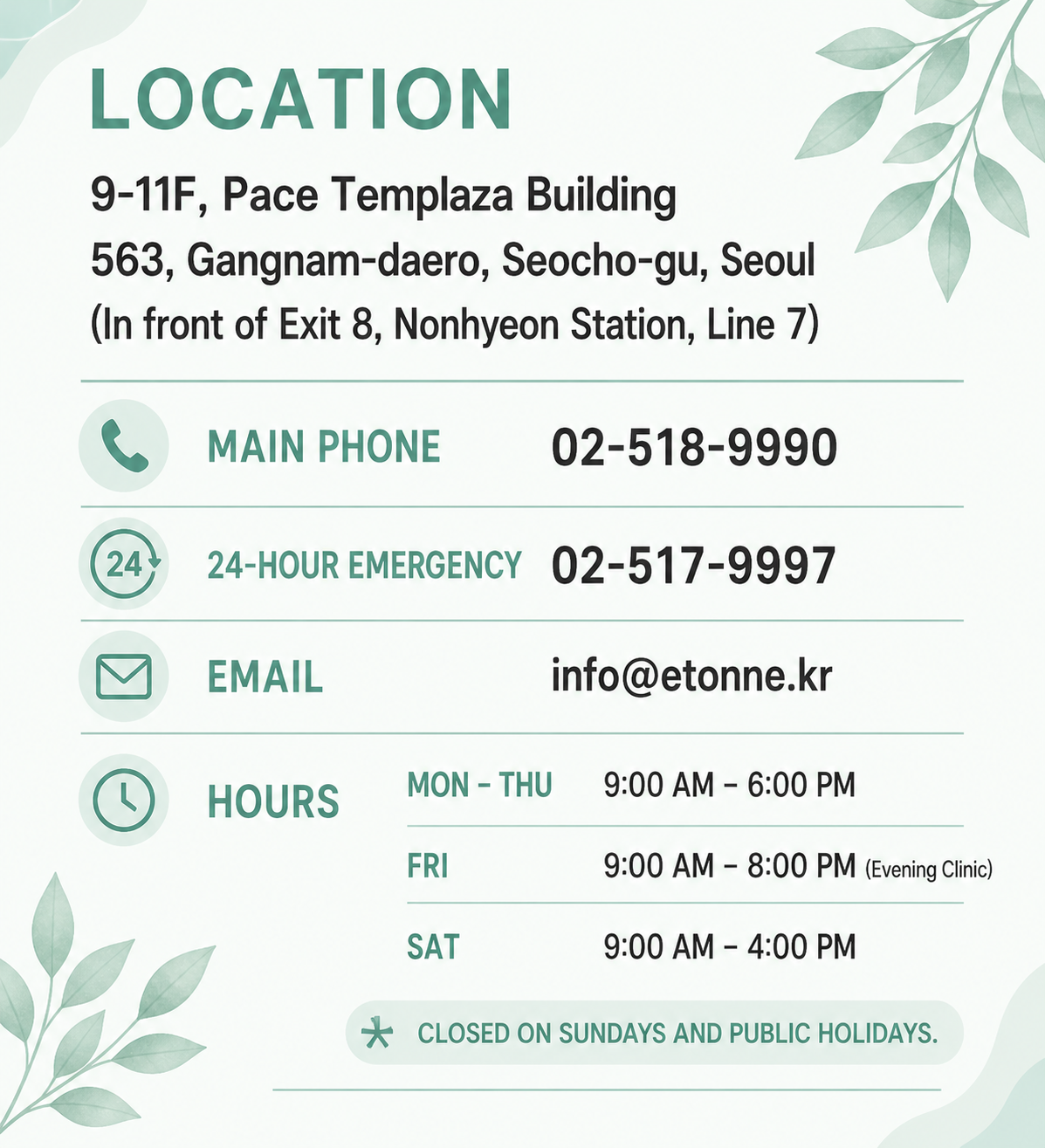
Address: 563 Gangnam-daero, Seocho-gu, Seoul, South Korea
Frequently Asked Questions
Can failed eyelid surgery be corrected?
Many failed eyelid surgeries can be significantly improved through personalized revision surgery. The amount of correction depends on scar tissue, remaining anatomy, and previous surgical techniques.
Why is revision surgery more difficult?
Revision procedures involve scar tissue and altered anatomy, making surgery technically more demanding than primary eyelid surgery.
How long should I wait before revision surgery?
Most surgeons recommend waiting approximately six to twelve months after the original procedure unless there is an urgent functional issue.
Can asymmetrical eyelids become symmetrical again?
Many patients achieve substantial improvement in eyelid symmetry, although perfect symmetry cannot always be guaranteed because natural facial asymmetry exists in nearly everyone.
Can multiple eyelid folds be corrected?
Yes. Multiple folds can often be improved by releasing previous scar adhesions and reconstructing a single natural eyelid crease.
Can ptosis surgery be revised?
Yes. Under-corrected or over-corrected ptosis surgery can often be revised after careful assessment of eyelid muscle function.
Will my scars become worse?
Revision surgery is designed to improve both eyelid appearance and scar quality while minimizing additional scar formation whenever possible.
How long should international patients stay in Korea?
Most revision eyelid surgery patients stay approximately one to two weeks, depending on the procedure and follow-up schedule.
Can I receive an online consultation?
Yes. Preliminary evaluation can usually begin with photographs and your previous surgical history before your visit to Korea.
Why choose ETONNE for revision eyelid surgery?
ETONNE emphasizes individualized surgical planning, meticulous scar management, natural-looking results, and comprehensive care for complex revision eyelid surgery cases.